Forest Hill South Crime: Why Residents Are Paying for Private Security
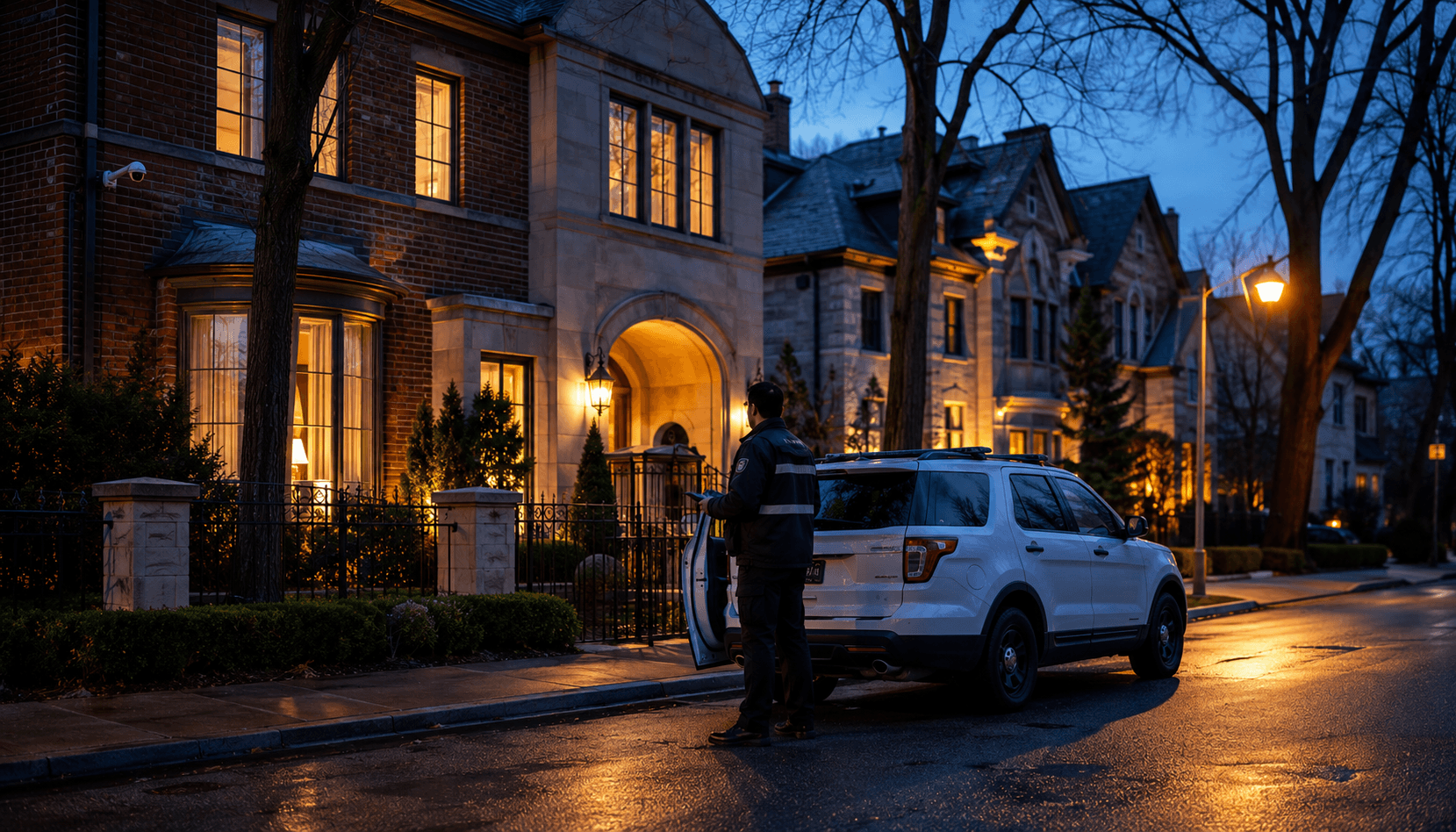
Walk through Forest Hill South after dark and a pattern stands out. Security cameras face the street from most homes. Many sliding doors and lower windows are fitted with folding security gates. Marked private security vehicles are scattered across the neighbourhood through the night.
None of this matches the neighbourhood's reputation on paper. Forest Hill South carries a Safety Score of 91 out of 100 — quieter than the typical Toronto neighbourhood and ranked 30th out of 158 city neighbourhoods by reported crime. So why does it feel like a community under siege?
The gap between the score and the fear
A Safety Score measures reported crime from Toronto Police open data — major incidents per year, weighted by severity, compared across the city. A score of 70 is typical for Toronto; 91 is genuinely low crime by that standard.
But low crime citywide can still mean concentrated anxiety locally, especially when the crimes that do happen are the ones that make headlines: break-and-enters targeting detached homes, auto theft from driveways, and — in the worst cases — home invasions where residents are home.
Toronto Police data for Forest Hill South over the last 12 months shows 83 reported major incidents. The breakdown tells the story residents are reacting to:
Property crime dominates. That aligns with what CBC News reported in 2025: while home invasions across Toronto hit a ten-year high in 2024, much of the surge involved houses in affluent areas — organized groups targeting luxury vehicles parked in driveways, often after scouting properties in advance.
The distinction matters. Toronto Police classify a home invasion only when a resident is present during the break-in. Many high-profile incidents in midtown are classified as break-and-enters committed to steal vehicles — still terrifying, but a different statistical category. Both have driven demand for private security in neighbourhoods like Forest Hill, Rosedale, and Lawrence Park.
A neighbourhood that dipped — and bounced back
Forest Hill South's Safety Score has not been a straight line. The annual history:
| Year | Safety Score |
|---|---|
| 2015 | 98 |
| 2020 | 88 |
| 2023 | 67 |
| 2024 | 77 |
| 2025 | 91 |
The 2023 dip to 67 coincided with a sharp rise in property crime rates in the published police data: auto theft rates per 100,000 residents jumped to roughly 790 that year (against about 106 in 2025), and break-and-enter rates peaked near 624 per 100,000 (against about 327 in 2025). The neighbourhood recovered significantly in 2024 and 2025 — but memories of that spike linger, especially among homeowners who upgraded security during the worst of it and have not torn it down since.
What private security actually does here
Several security firms explicitly list Forest Hill South among neighbourhoods they patrol. Flex Point Security's neighbourhood watch program, for example, offers mobile patrols, GPS-tracked route reports, and a "home dispatch" line — residents who hear something at night can call and dispatch a nearby guard to investigate.
That model differs from a full-time officer on every doorstep, but the visible presence is similar: a car on the block, a uniformed guard who knows the street, a deterrent aimed at thieves who want the easiest target on the block — not the one with cameras, gates on the sliding doors, and a guard idling at the curb.
The Globe and Mail documented a parallel response in Rosedale, where families hired standing guards outside homes at night after masked groups forced entry in early-morning hours, sometimes while children were inside. One family described hiring a car and guard to watch the property overnight after a break-in while they were away on business. Forest Hill South residents describe a similar landscape — patrol cars scattered across the neighbourhood overnight, not just outside one or two houses.
CBC News profiled the wider trend in 2025: physical hardening — security gates on sliding doors and lower windows, upgraded alarm systems, and private patrols layered on top of whatever police can provide. City councillors have pressed Toronto Police for briefings; the hold-up squad presented data on vehicle-related break-ins to the police board in April 2025.
What police are doing in this division
Forest Hill South sits in Toronto Police 53 Division, alongside Rosedale-Moore Park, Leaside-Bennington, Casa Loma, and Mount Pleasant East — many of the same midtown neighbourhoods appearing in home-invasion coverage.
In response to an early-2025 uptick, Toronto Police launched Project AEGIS in 53 and 32 Divisions: marked and covert cars patrolling overnight to deter vehicle-targeting break-ins. CBC reported that home invasions in those divisions dropped sharply after the project began compared with the first two months of the year. Police also note that these crimes often involve organized groups working across the GTA, not opportunistic local theft — which is part of why residents feel police presence alone is not enough.
A community safety meeting in nearby Casa Loma in May 2025 drew roughly 100 residents after break-ins "most noticeably evidenced in neighbouring Forest Hill." Police reported eight break-ins in the Casa Loma area since the start of the year and emphasized practical steps: cameras, trimmed sightlines, locked doors, and reporting suspicious activity — the same toolkit private patrols are meant to supplement, not replace.
How Forest Hill South compares to nearby hoods
Affluent does not mean immune. Published 2025 rates per 100,000 residents show break-and-enter remains material even in wealthy pockets:
| Neighbourhood | Safety Score | Break-and-enter rate | Auto theft rate |
|---|---|---|---|
| Forest Hill South | 91 | 327 | 106 |
| Forest Hill North | 97 | Lower | Lower |
| Rosedale-Moore Park | 68 | 456 | 200 |
| Bridle Path-Sunnybrook-York Mills | 78 | 403 | 197 |
| Lawrence Park South | 95 | Lower | Lower |
Forest Hill South is safer than Rosedale-Moore Park on the overall score and has lower break-and-enter rates than both Rosedale and the Bridle Path — but 34 break-and-enters in 12 months is still enough to keep a community vigilant when each incident might involve a masked group and a six-figure vehicle in the driveway.
Violent crime rates here remain comparatively modest: roughly 196 assaults, 74 robberies, and zero shootings or homicides per 100,000 in the latest published year. The anxiety is driven by property crime and the rare but vivid home-invasion stories that circulate between neighbours and in local news — like the December 2024 armed break-in near Avenue Road and Chaplin Crescent, where masked suspects smashed through a door with a hammer while homeowners were inside, a few minutes' drive from Forest Hill.
What the security stack on the street suggests
The cameras, the gates, and the overnight cars are not random. They reflect a set of threats Toronto homeowners have been warned about repeatedly:
- Relay attacks on key fobs for vehicles parked outside
- Early-morning entries when residents are asleep or away
- Scouting runs — suspects seen on camera days before a strike
- Targets chosen for visible luxury vehicles and perceived empty homes
Security gates on sliding doors and lower windows add a physical barrier before someone can reach the glass. Cameras extend visibility beyond what a patrol car can cover. The car on the block signals that someone is watching. None of it guarantees safety — but thieves selecting the softest target on the street may move to a block without those layers.
Private patrols also do not replace calling 911. Toronto Police remain the authority for crimes in progress. The private layer is deterrence and faster eyes on the ground — a neighbourhood response to a problem that spiked citywide but landed hardest on streets with the most to lose.
How to check your own address — or a home you are considering
Whether you live in Forest Hill South, are comparing nearby streets, or are thinking about buying in the area, the same police open data residents pay security firms to react to is available free:
- Open the Toronto crime map and search any address in the neighbourhood.
- Review the Safety Score, the 12-month incident table, and the year-by-year trend chart back to 2014.
- Filter the table to break-and-enter and auto theft to see what is actually happening within 250–500 m of the property — not just the neighbourhood average.
- Visit the full Forest Hill South neighbourhood page for border-to-border stats, rate history, and FAQ.
If you want ongoing updates without checking back, set up a free email alert for a specific address — daily or weekly digests when new reports appear nearby.
The bottom line
Forest Hill South is objectively one of Toronto's quieter neighbourhoods by reported major crime — a Safety Score of 91 is not marketing, it is the output of police open data. But 34 break-and-enters in a year in a compact residential pocket is enough to explain the cameras, the gates, and the security cars scattered across the neighbourhood at night.
The neighbourhood's response is less about statistics on a page and more about a specific wave of organized property crime that scared midtown homeowners in 2023–2024, left security upgrades in place, and keeps private patrols economically viable on street after street. Police projects like AEGIS help; they have not made the private cars disappear.
If you are researching the area — as a resident, a buyer, or a neighbour comparing blocks — start with the data, then walk the street after dark. The score and the security presence tell different parts of the same story.
Data source: Toronto Police Service open data (Major Crime Indicators and year-to-date feed), current through early July 2026. Safety Scores and rates are calculated from published neighbourhood crime statistics — see our methodology. This article is independent editorial; Safety Score is not affiliated with Toronto Police or any private security firm mentioned.